Corrosion is one of the biggest threats to the durability and performance of metal products used in modern industries. From automotive components and industrial fasteners to electrical enclosures and marine equipment, metals are constantly exposed to moisture, salt, chemicals and polluted atmospheres. These environmental factors slowly degrade protective coatings, resulting in rust formation, surface pitting and coating failure. Corrosion does not only spoil the appearance of a product but also weakens its mechanical strength, reduces its service life and leads to frequent breakdowns, warranty claims and loss of customer trust.
To avoid such failures, manufacturers perform corrosion resistance testing using a laboratory instrument called a Salt Spray Chamber, also known as a Salt Spray Test Machine. This testing equipment helps simulate highly corrosive environments in a controlled laboratory setting and provides valuable insight into how coatings and metal finishes will behave under harsh real-world conditions.
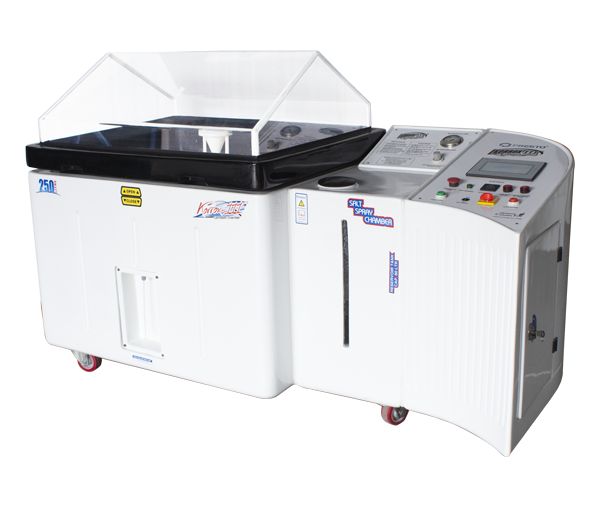
Table of Contents
ToggleWhat is a Salt Spray Chamber?
A Salt Spray Chamber is a specialized corrosion testing instrument designed to create a dense salt fog atmosphere inside a sealed chamber. The purpose of this environment is to reproduce aggressive marine and industrial climates that accelerate corrosion reactions on metal surfaces. Instead of waiting months or years for corrosion to develop naturally, manufacturers can observe coating failures within a short period of time.
Salt spray testing is conducted according to internationally recognized standards such as ASTM B117, ISO 9227, JIS Z 2371, DIN 50021 and BS 7479. These standards define the test parameters, solution composition, temperature conditions and acceptance criteria that ensure uniformity and reliability of test results across laboratories worldwide.
Why Salt Spray Testing is Important
Metal products are rarely used in controlled indoor environments. They face constant exposure to humidity, road salts, rainwater, acidic vapors and industrial pollutants. Even premium quality coatings may fail prematurely if not tested under simulated corrosive conditions.
Salt spray testing helps manufacturers detect coating defects at an early stage, compare different surface treatments, validate the quality of supplier materials and improve product design. This testing method plays a crucial role in preventing field failures, reducing customer complaints and ensuring that only corrosion-resistant products reach the market.
Working Principle of a Salt Spray Chamber
The working principle of a salt spray chamber is straightforward yet extremely effective. A five percent sodium chloride solution is prepared using high-purity salt and demineralized water. This solution is stored in a reservoir tank connected to the chamber’s atomizing system. Compressed air passes through a saturation tower to regulate humidity before entering the spray nozzle.
The nozzle atomizes the salt solution into a fine mist which is continuously sprayed inside the chamber. This mist forms a dense salt fog that uniformly settles on the test specimens, initiating corrosion reactions on exposed metal surfaces.
The chamber temperature is maintained at approximately thirty-five degrees Celsius with minimal variation. The pH value of the salt solution is carefully controlled between 6.5 and 7.2 to maintain neutral conditions. Test specimens are placed on non-metallic racks inside the chamber at an inclined angle to ensure uniform exposure to the salt fog.
Test Duration and Result Evaluation
The duration of the salt spray test depends on product type, industry application and customer specifications. Typical exposure periods range from twenty-four hours to several hundred hours. After completion of the test cycle, samples are removed from the chamber, gently rinsed with demineralized water and visually examined.
During evaluation, inspectors look for red rust formation, white rust, blistering, cracking, peeling of coatings and any visible signs of surface degradation. These observations help determine whether the coating meets performance requirements or needs further improvement.
Types of Salt Spray Tests
There are different variants of salt spray testing used for specific applications. The neutral salt spray test is the most common and is used for zinc plating, powder coating, galvanizing and anodized surfaces. The acetic acid salt spray test is performed under acidic conditions and is mainly used to test decorative nickel-chrome coatings. The copper accelerated acetic acid salt spray test is the most aggressive method and is used for evaluating premium decorative finishes in automotive and sanitary industries.
Construction of a Salt Spray Chamber
A modern salt spray chamber is constructed using corrosion-resistant materials such as PVC or fiber-reinforced plastic to ensure long-term durability. The chamber is equipped with a digital temperature controller, air saturator tower, atomizing nozzles, salt solution reservoir tank and fog collection system. Specimen racks are made of non-metallic materials to avoid interference with the test environment.
Advanced models also include programmable controllers, safety alarms and automatic timers to improve accuracy and user convenience.
Applications of Salt Spray Testing
Salt spray chambers are widely used across automotive manufacturing, fastener production, paint and plating industries, electrical panel manufacturing, consumer appliance production, marine equipment fabrication and aerospace engineering. These industries depend on salt spray testing to ensure that their products can withstand extreme environmental exposure without corrosion-related failures.
Benefits of Salt Spray Testing
Salt spray testing helps manufacturers predict coating performance under harsh environments, improve product reliability, support research and development activities and ensure compliance with international quality standards. It also helps reduce warranty costs, enhance customer satisfaction and build a strong brand reputation.
Limitations of Salt Spray Testing
Although salt spray testing is highly effective for comparative analysis, it does not perfectly replicate natural environmental conditions. It provides accelerated corrosion data rather than exact service life prediction. Therefore, it is often combined with cyclic corrosion tests and real-world exposure studies for comprehensive evaluation.
Why Choose Presto Salt Spray Chamber?
Presto’s Salt Spray Chambers are engineered with high-quality corrosion-resistant materials and advanced digital controllers to deliver consistent, accurate and repeatable test results. These chambers ensure uniform fog distribution, precise temperature control and reliable performance over long testing cycles. With user-friendly interfaces and compliance with global standards, Presto salt spray chambers provide a dependable solution for corrosion testing needs.
Conclusion
A Salt Spray Chamber is an essential quality control instrument for industries dealing with metal coatings and surface protection. It allows manufacturers to identify coating weaknesses, improve product durability and meet international quality benchmarks. By investing in a high-performance salt spray test chamber, companies can ensure long-lasting products, reduced failure rates and improved customer confidence.
Call to Action
If you want to evaluate the corrosion resistance of your products with high accuracy and consistency, choose the Presto Salt Spray Chamber.
📞 Call: +91 9210 903 903
📧 Email: info@prestogroup.com
🌐 Enquire Now: https://www.prestogroup.com/contact-us/